

MArch Students Awarded AIA Graduate Fellowship in Health Facility Planning and Design
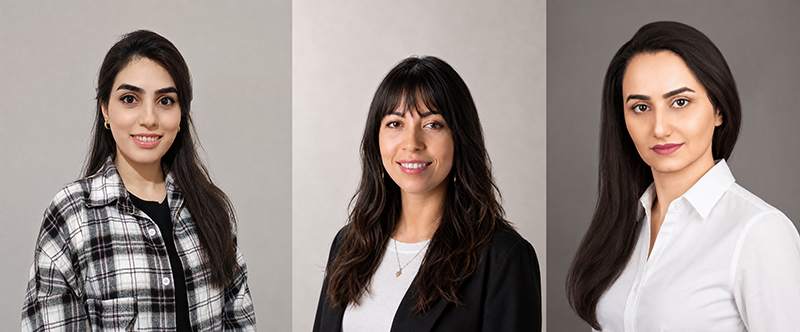
Master of Architecture students Fransis Lopez Bustillo, Dorna Jokar, and Mehrnaz Pasokhi were awarded the 2026–2027 American Institute of Architects (AIA) Arthur N. Tuttle, Jr. Graduate Fellowship in Health Facility Planning and Design.
Theor proposal “Spatial Strategies for Integrating Nursing Homes and Foster Care Environments: Enhancing Interaction, Safety, and Mental and Physical Wellbeing in Intergenerational Care” focuses on developing an Intergenerational Care Design Toolkit for residential childcare facilities and nursing homes. It explores how shared and transitional spaces can be designed to encourage intergenerational interaction while also addressing the distinct needs of both groups.
An important aspect of the research is that intergenerational design involves more than bringing older adults and children into the same building, Bustillo said. It also requires spaces that encourage interaction while also preserving choice, safety, privacy, and independence.
Fellowship for Health Design
The fellowship will allow the research group to dedicate focused time to investigating the topic, strengthening the research process, and expanding our work beyond the initial concept, Jokar said.
“The fellowship provides an important opportunity to expand my graduate studies and engage in a more in-depth research process. It will support our research, case study investigations, and participation in professional conferences, where we can learn from healthcare design professionals and researchers,” Pasokhi said.
“Receiving the Arthur N. Tuttle Jr. Graduate Fellowship is very meaningful to me because it recognizes the potential of our research to address real social and architectural challenges,” she said. “I am especially grateful for the opportunity to work on a project that connects architectural design with human well-being and the needs of vulnerable populations. The fellowship also gives me the opportunity to grow as a researcher and connect academic research with professional practice.”
“Being a graduate student at the LSU School of Architecture has given me the opportunity to explore architecture from both design and research perspectives,” Pasokhi said. “I especially value the support and mentorship I have received from faculty and the opportunities to work on projects addressing real environmental and social challenges.”
“My experience at LSU has encouraged me to think about architecture as a way to improve people’s everyday experiences and quality of life.”
“I see this fellowship as an opportunity to apply what I have learned in my graduate courses to a year-long research project,” said Bustillo, MArch ‘27. She is also a graduate assistant in the LSU Coastal Ecosystem Design Studio (CEDS). “My studio experience has taught me that strong design decisions are grounded in thoughtful research, while my current Research Methods course is helping me approach that process more systematically. The fellowship allows me to strengthen the connection between research and design which supports my long-term interest in academia.”
“This award is especially meaningful to me because it supports my first formal research experience in architecture while reconnecting me with a field in which I previously worked,” she said. “During my time in healthcare settings, I witnessed firsthand the way architecture and interior design influence the experiences and therefore behaviors of patients, families, and staff. This fellowship gives me the opportunity to revisit those observations from the perspective of an architectural designer and researcher.”
“This award is a significant milestone for me because it demonstrates that my strengths extend beyond the design studio into research. It reassures me that my academic inquiries are valued, giving me the encouragement and resources to develop further as both a designer and a researcher,” Jokar said.
LSU School of Architecture Experience
“My experience as a graduate student at the LSU School of Architecture has introduced me to new ways of thinking about architecture, research, and design. Working with my professors and classmates on different projects has helped me deepen my understanding of my areas of interest while also building connections that encourage me to continue pursuing research and collaboration,” Jokar said.
“I entered the LSU School of Architecture from a very different academic and professional background, but I have always felt welcomed and encouraged to push beyond what I thought I was capable of,” Bustillo said.
“One thing I especially value is that I have learned to translate those previous experiences into a design perspective that gives my work a personal point of view. This supportive environment has encouraged me to continue developing within the field and has sparked my interest in pursuing a future in academia.”